ADORe 1 million € NEURON Grant
Project aim. We will i) describe neural and cognitive functions implicated in adolescent onset depressive symptoms, and their involvement...
[Event]
The targeting adolescent neurocognitive processes in depression to promote intervention response (ADORe) is a multi-site international study that aims to elucidate, in a translational perspective, neural and cognitive functions implicated in adolescent onset of depression and in treatment response. The study is funded by the Network of European Funding for Neuroscience Research.

The World Health Organization "Health for the world’s adolescents" report revealed that depression is the predominant cause of illness and disability and among the top three causes of mortality for adolescent boys and girls. Recent studies point to lasting effects of adolescent onset depression, including risk for treatment-resistance in adulthood.
Along these lines, It is now necessary to better understand how trajectories of neural and cognitive changes during adolescence, particularly at the sub-clinical level, will predict resilience or vulnerability to MDD and to use this knowledge to refine traditional intervention approaches and to develop novel intervention components that better target developmental mechanisms of risk. There is a need for better prevention, particularly targeted approaches that address the needs of those most vulnerable to depression.
The World Health Organization "Health for the world’s adolescents" report revealed that depression is the predominant cause of illness and disability and among the top three causes of mortality for adolescent boys and girls. Recent studies point to lasting effects of adolescent onset depression, including risk for treatment-resistance in adulthood.
Along these lines, It is now necessary to better understand how trajectories of neural and cognitive changes during adolescence, particularly at the sub-clinical level, will predict resilience or vulnerability to MDD and to use this knowledge to refine traditional intervention approaches and to develop novel intervention components that better target developmental mechanisms of risk. There is a need for better prevention, particularly targeted approaches that address the needs of those most vulnerable to depression.
Using three exceptional cohorts which have recently completed long-term follow-up of adolescents at varying risk for depression, we will search for deviations of brain and cognitive functions involved in the transition to early-onset depression and subsequent to early onset depression; and we will recruit new samples to determine the role of these deviations in treatment response. Cohorts are as follows:
1) Bucharest Early Intervention Project (BEIP)
2) IMAGEN European cohort and
3)CoVenture/NeuroVenture Canadian cohort.
Measures will be highly harmonized across experiments in animals and analyses in humans, including complementary intervention approaches.
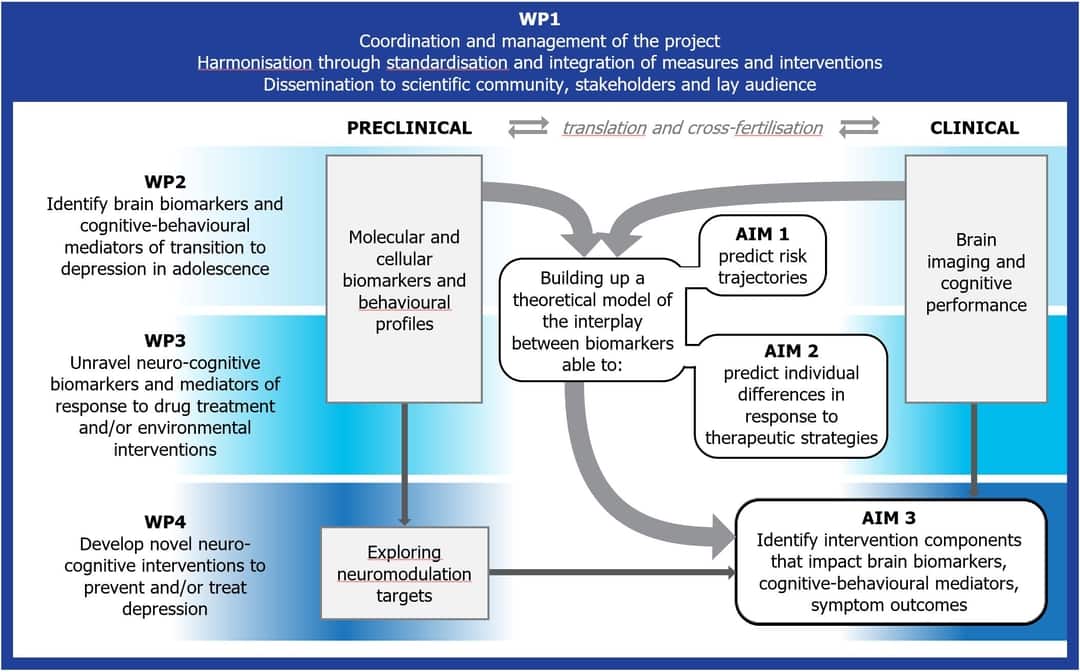
The causal role of cerebral or environmental factors on the deviations of cognitive functions and behaviours, and on intervention response, will be tested in animal studies and using existing databases from at risk youth. The ADORe consortium will conduct researches on humans and animals, aiming to provide novel intervention components for at-risk individuals during the critical adolescent period. The researches will be focused on core brain regions and cognitive functions (reward, memory, stress response, and self-referent thinking) developing in adolescence, and relevant to depression risk. In the final year of the project, promising targeted neurocognitive interventions will be identified, adapted and tested at proof-of-concept level in two at-risk adolescent samples: one resistant to psychosocial intervention and the other exposed to severe childhood adversity.
Neural and cognitive-behavioural measures will be highly harmonized across studies and species. By focusing on the correspondence between brain systems and cognitive and emotional functions, our project will provide novel insights into the mechanisms underlying the onset of depression in adolescence and its role in depression, and will potentially advance knowledge in prevention and treatment of adolescent depression, a field that has not progressed substantially in recent years.